Sunday, May 17, 2015

States of Consciousness

Sleep - State of consciousness - less aware of surroundings
Biological Rhythms

  • Annual - Seasonal Variations (Hibernate, SAD)
  • 28 Day - Menstrual
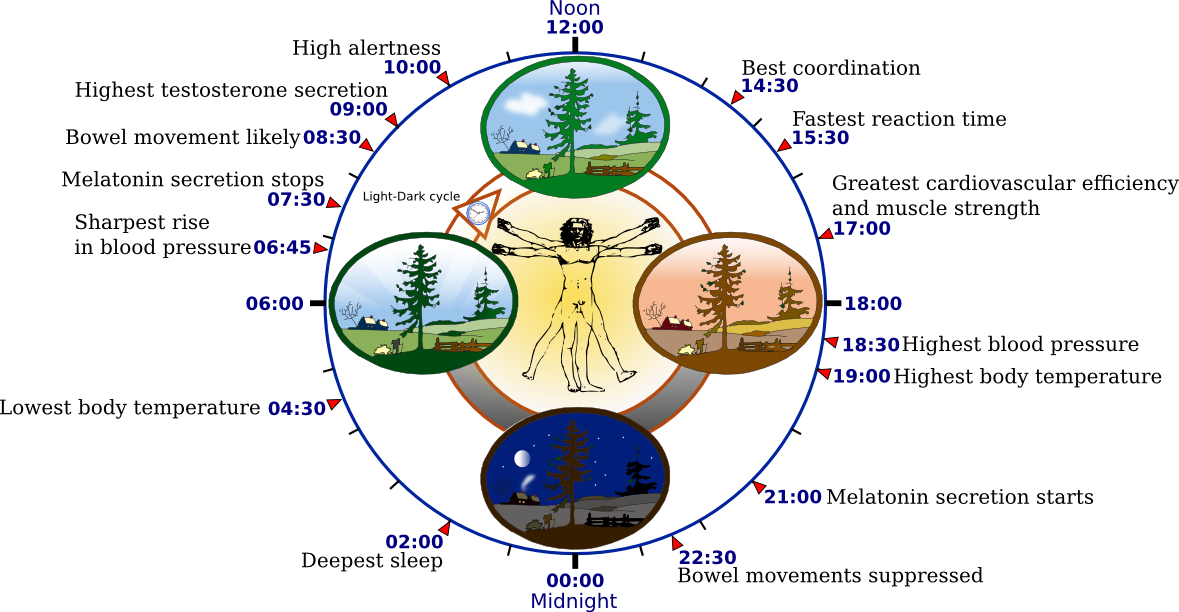
  • 24 H - Circadian Rhythm
  • 90 min - Sleep Cycles
Circadian Rhythm - Bio Clock; Bodt temperature & awareness change throughout the day

Sleep Stages

5 stages; takes 90-100 min; brain waves change depending on the stage.
1st 4 stages -> Non REM Sleep        5th stage -> REM sleep
  1. Stage 1 - Awake-ish & asleep-ish; small duration during the night. eyes slightly roll, Theta waves
  2. Stage 2 - Baseline, part of 90 min. cycle (45-60% of sleep); more theta waves -> slows down; show sleep spindles - short bursts of brain activity
  3. Stages 3 and 4 - Slow wave sleep w/delta waves; if awakened, very groggy; restores body's growth hormones and good overall health. IMPORTANT
    • 15-30 min.; slows brain activity -> delta waves have higher amp; DEEPEST SLEEP; Delta sleep needed by sleep-deprived; 40% of sleep time in children ("dead asleep")
  4. REM Sleep - Very active sleep; stage of sleep; body paralysis; 20-25% of sleep; breathing, brain activity, and heart rate increase; REM -> Stage 2

Sleep Disorders

  • Insomnia - Recurring problems falling asleep or staying asleep; not from avg. amount of sleep
  • Narcolepsy - Uncontrollable sleep attacks; Directly to REM sleep (from joy or fear)
  • Sleep Apnea - Temporary cessations in breathing while asleep and consequent momentary awakenings
  • Night Terrors - High arousal and terrified appearance in stage 4; forgotten
  • Sleepwalking - During deep nonREM sleep early in the night
 --
Dreams - Sequence of images, emotions, and thoughts through a sleeping person's mind
  • Manifest - Remembered storyline of a dream
  • Latent - Underlying meaning of a dream
Theories 
  • Freud - Key to understand hidden conflicts; ideas and thoughts hidden in unconscious
  • Information Processing - Dreams act to understand and sort out memories of the day
    • REM sleep increases after stressful events
  • Activation Synthesis - Brainstem reduces random neural activity, dreams try to interpret that activity.

Language

Language - Our spoken, written, or gestured words and the way we combine them to communicate meaning.

-emes

  • Phonemes - Spoken language - smallest distinctive sound unit [chug - ch, u, g]
  • Morphemes - Smallest unit that carries meaning; a word or part of a word

Grammar - System of rules in a language that allows us to communicate and understand others.

  • Semantics - Set of rules by which we derive meaning in a language. EX: -ed = past tense
  • Syntax - Rules for combining words into grammatically sensible sentences

Language Development

  1. Babbling Stage - 3-4 mo.; infant makes sounds, not limited to phonemes
  2. One word stage - 1-2 yrs.; one word to communicate meanings
  3. Two word stage- 2 yrs.; two words to comm.- telegraphic speech
Social Learning Theory - Skinner; Pick up through socialization
Chomsky - Acquire language too quickly to learn it; "Learning box" in head allows us to learn any human language [Inborn Universal Grammar]
Whorf's Linguistic Relativity - Language determines the way we think

Thinking

Cognition - Thinking, knowing and remembering

  • Concepts - To think about the world, mental grouping of similar objects, ideas, people
    • Like schemas
    • Based on prototypes - mental image or best example of category

Solving Problems


  • Trial & Error
  • Algorithms - Methodical logical rule or procedure that guarantees solving a particular problem.
  • Heuristics - Strategy that allows us to make judgement and solve efficiently; shortcut prone to errors
  • Insight - Sudden and novel realization of solution to problem

Obstacles

  • Confirmation bias - Likelihood to search for info to confirm self perceptions
  • Fixation - Cannot see problem from other view
  • Mental Set - Likelihood to approach problem in a particular way esp. if it worked in the past.
  • Functional Fixedness - Likelihood to think of many things only in terms of their usual functions

Types of Heuristics

  • Representativeness - Rule of thumb for judging the likelihood of things in terms of how well they match our prototype; can make us forget important info.
  • Availability - Est. the likelihood of events based on avail.; memory comes into mind easily = common
--
Overconfidence - Likelihood to be more confident than correct; overestimate accuracy of beliefs and judgements.
Framing - Why issue is posted -> drastically affects decisions and judgements
Belief Bias - Likelihood for one's initial beliefs to distort logical reasoning; makes invalid conclusions valid or vice versa.
Belief Perseverance - Clinging to your initial conceptions after basis of being discredited.

Memory

The persistence of learning over time through the storage and retrieval of information

Recall vs. Recognition

  • Recall - Retrieve info from memory
  • Recognition - Identify target from possible targets

Memory Process

  1. Encoding - Processing of information
  2. Storage - Retention of encoded material over time
  3. Retrieval - Getting info out of storage
Sensory Memory - A half second holding tank for all sensory info; Iconic/Echoic Memory
Short Term Memory - Encoded from STM; encoded visually, acoustically, or semantically; holds 7 items for 20 seconds; works better with numbers

Methods to convert STM to LTM

  • Chunking - Organizing items into familiar, manageable units.
  • Mnemonic Devices
  • Rehearsal
Long Term Memory - Limitless storehouse of information
  • Explicit (declarative) memories; includes episodic and semantic memories
  • Implicit (non-declarative) memories; includes procedural and conditioned memories
Encoding Information - Serial positioning effect 
  • Primary - We remember the first items the best
  • Recency effect - We remember the last items after just hearing them 
Spacing effect - Ebbinghaus's forgetting curve
Encoding ways
  • Visual - Encoding pictures
  • Acoustic - Encoding of sound, esp. sound of words
  • Semantic - Encoding meaning
Flashbulb Memories - Memories of significant events
Mood Congruent Memory - Memories retrieved match current mood
State Dependent Mood - Memories retrieved match current state

Forgetting
  • Retroactive interference - New info blocks out old info
  • Proactive interference - old information blocks out new information
Long Term Potentiation
  • Long-lasting improvement in signal transmission between two neurons that results fro stimulating them synchronously
  • Improved efficiency creates memories
Train your memory!

Tuesday, April 7, 2015

Developmental Pyschology

Study of you from womb to tomb.
Nature vs. Nurture - Way you were born / Way you were raised

Physical Development (Or the Way You Grow)

Prenatal - Begins with egg and sperm fertilized = zygote
  1. Zygote - Lasts two weeks with rapid cell division.
    • Less than half of all zygotes survive first two weeks
    • Attaches to uterine wall after ten days
    • Placenta - Outer part of zygote; Filters oxygen and nutrient
     2.  Embryo - After two weeks, lasts for six weeks.
    • Heart beats and organs develop
     3.  Fetus - After nine weeks; Organs formed enough for independent survival.

Teratogens - Chemicals that can harm prenatal environment. EX: Alcohol (FAS), STDs, HIV, Herpes, Drugs.

Reflexes

Inborn automatic responses
  • Rooting - When a newborn infant is touched on the cheek, infant turns its head toward the source of stimulation.
  • Grasping - If an object is placed into a baby's palm, baby will try to grasp object with fingers.
  • Moro - When startled, baby will fling limbs out and quickly retract them.
  • Babinski - When a baby's foot is stroked, it will spread its toes.
Maturation - Physical growth processes enable orderly changes in behavior, regardless of environment.
Cognition - Mental activities w/thinking, knowing, and remembering.

Cognitive Development

Researched by Jean Piaget
  • Schemas - Way to interpret world
  • Assimilation - Incorporating new experiences into existing schemas
    • High School - Meet someone -> assimilate into schema.
  • Accomadation - Changing an existing schema to adapt to new information.

Piaget

  • Sensorimotor - Experience world through senses
    • Object Permanence - 6-8 months of age
  • Preoperational - 2- 6 or 7 - Use language to represent objects and ideas; "Magical Thinking" 
    • Conservation - Quantity is the same despite changes in appearance; part of logical thinking.
  • Concrete Operational - Demonstrate conservation, logic think, understanding of reversibility.
  • Formal Operational - Abstract reasoning, hypothesis testing, reasoning with metaphors and analogies.
  • Criticisms
    • Information-Processing Model - Children learn in continuous growth pattern
    • Underestimates children's ability; Attention span grows over time.

Social Development

  • > 1 year - infants indifferent to stranger
    • Stranger anxiety - After one year, common in infants.

Attachment

  • Most important social construct (bond with caregiver)
  • Animals form attachment through imprinting (Konrad Lorenz)
    • Origins - Harry Harlow used monkeys; needed touch or body contact to form attachment. (Cloth vs. Wire)
Critical Period - After birth organism's exposure to certain stimuli or experiences produce proper development.

Types of Attachment
  • Secure - Some distress when parent leaves, seek contact at the reunion, explore when parent gone, play and greet when parent present.
  • Separation Anxiety - Anxiety when infant loses object of attachment. 14 to 18 months

Parenting Styles

  • Authoritarian - Strict standards for behavior
  • Permissive - Allows freedom, lax parenting, don't enforce rules consistently
  • Authoritative - Reasonable standards of expectation, encourage independence.

Stage Theorists

Believe we travel from stage to stage throughout lives.

Freud - Libido, travels though body in development.
  1. Oral (0-1) - Pleasure by mouth
  2. Anal Stage (1-3) - Controlling & Expelling waste
  3. Phallic Stage - Recognize gender, Oedipus/Electra complex
  4. Latency (6-11) - Cooties
  5. Genital Stage - Libido in genitals, feelings toward others.

Adolescence

Transition from childhood to adulthood
  • Puberty - Sexual maturation -> becomes capable of reproducing
    • Primary Char. - Body structures that make production possible
    • Secondary Char. - Non-reproductive sexual char.
      • Landmarks - Menarche, Spermarche

Adulthood

Physical abilities peak by mid-twenties
  • Milestones
    • Menopause - Ending of woman's ability to reproduce

Intelligence

  • Crystallized - Accumulated, increases with age
  • Fluid - Ability to solve problems quickly and think abstractly; Peaks in 20s and then decreases.
Alzheimer's - Progressive and irreversible deterioration of memory, language, and physical functioning. Caused by less ACH.

Life Expectancy

Around 75; Women outlive men by 4 years; Men conceived 126 to 100; 105 to 100 by birth.

Death

Stages of Death/Grief
  1. Denial
  2. Anger
  3. Bargaining
  4. Depression
  5. Acceptance

The Brain

Accidents - Story of Phineas Gage - Accident changes personality
Lesions - Removal or destruction of some part of the brain (Frontal Lobotomy)
Electroencephalogram (EEG) - Detects brain waves thru electrical output. Used in sleep research.
CAT Scan - 3D X-ray of brain. Useful in locating tumors, but not its functions.
MRI - Detailed picture of brain using magnetic fields. Results in movie of multiple images.
PET Scan - Measures chemical use of brain (glucose common) with injection of chemicals

Hindbrain

Top; controls basic biological structures
  • Medulla Oblongata - Above spinal cord; controls blood pressure, heart rate, breathing.
  • Pons - Above Medulla; connects hind to mid and fore; controls facial expressions
  • Cerebellum - Bottom rear "little brain"; controls fine muscle movements.

Midbrain

Coordinates simple movements w/sensory information
  • Reticular Formation - Controls arousal and ability to focus our attention

Forebrain

Largest; "humanity" - Thalamus, Limbic system, and Cerebral Cortex.
  • Thalamus - Switchboard; Interp. sensory signal and sends to forebrain; every sense except smell.

Limbic System

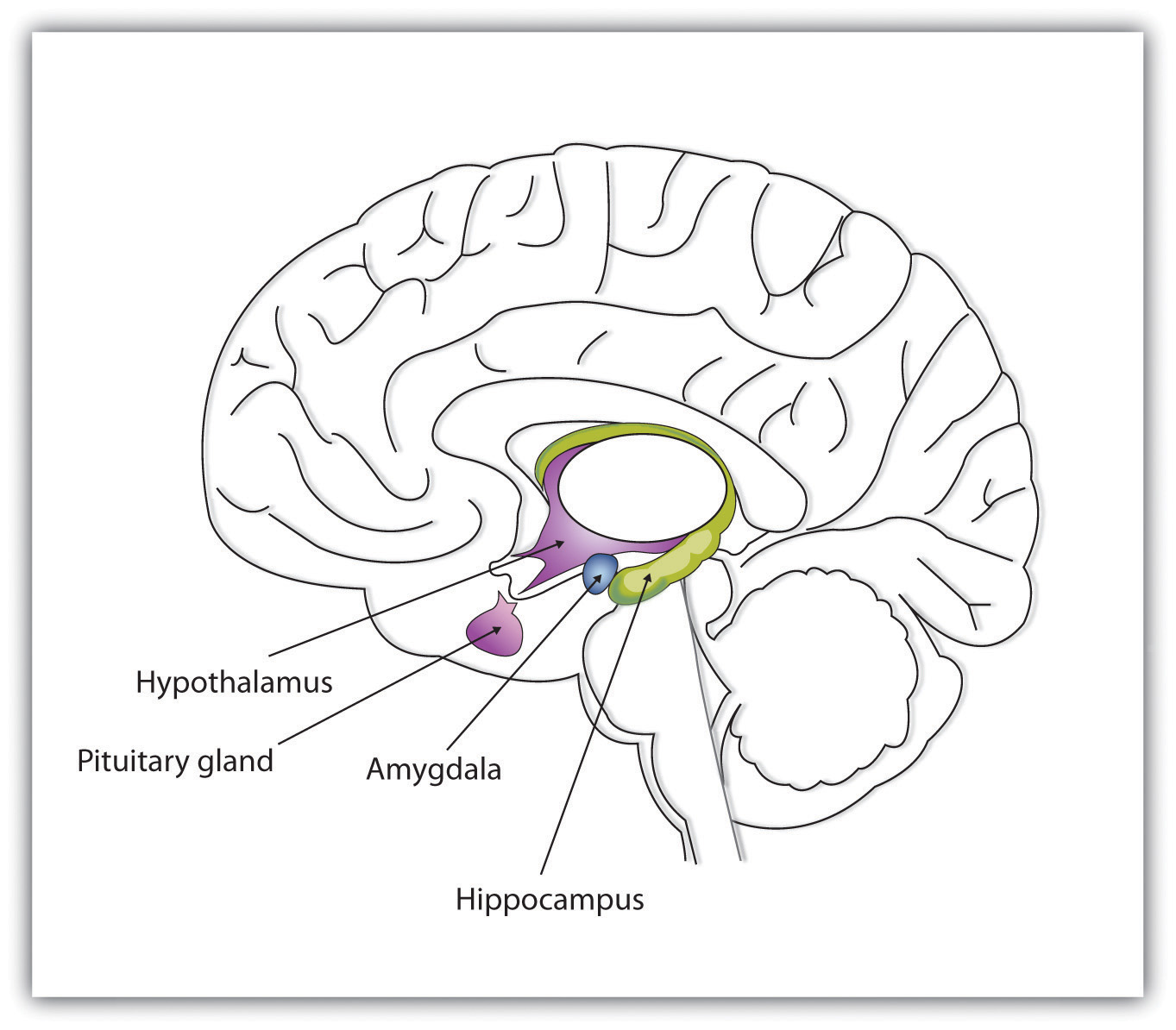
  • Hypothalamus - Important; controls and regulates body temp., sexual arousal, hunger and thirst, Endocrine.
  • Hippocampus - Processing and storage of memories.
  • Amygdala - How to process memory, involved in volatile emotions
Cerebral Cortex - Made up of densely packed neurons (grey matter) Glial cells: support brain cells. 
Fissures - Wrinkles in the cerebral cortex.

Hemispheres and Lobes

Contralateral Control - Right controls left and vice versa.
  • Left - Logic and sequential tasks
  • Right - Spatial and creative tasks

Frontal Lobe

  • Motor Cortex - Sends signals to our body controlling muscles
  • Broca's Area - Controls muscles producing speech
    • Aphasia -  Damaged; unable to make movements to talk.

Parietal Lobe

  • Sensory Cortex - Receives incoming touch sensations from body
    • Made up of Association Areas - Not associated with receiving sensory info or coordinating muscle mov.

Occipital Lobe

Vision - Vision Cortex - Interp. messages from eyes into understandable messages.

Temporal Lobe

Process sound sensed by our ears with Auditory Cortex
  • Wernicke's Area - Interp. written and spoken speech
    • Aphasia - Unable to understand language; poor syntax and grammar.

--------------------------------------------------------------------------------------------------------------------------

Brain Plasticity - When the brain is damaged, it will try to find new ways to reroute messages.
Corpus Callosum - Bridge of nerve fibers that connects or divides the two hemispheres.
Cerebrum - Largest part - Divided left, right, and lobes, Contains Cerebral Cortex, Controls voluntary movement, Coordinates mental activity; Center for all conscious living.


Biological School

Nervous System

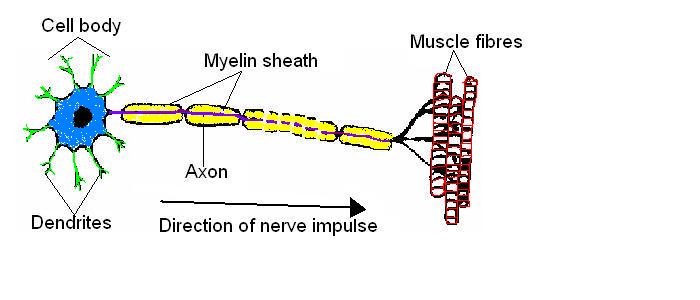
  • Starts with the neuron

Firing Methods

  • Resting Charge - Slightly neg charge
  • Reach threshold if enough neurons reach dendrites
  • Go into Action Potential (firing)
All or None Response - Fires or not; no in-between

Neurotransmitter - Chemical messages released by terminal buttons

  • Acetylcholine (ACH) - Motor movement and memory. Less = risk of Alzheimer's
  • Dopamine - Motor movement and alertness. Less = Parkinson's  /  Excess = Schizophrenia
  • Serotonin - Mood control. Less = Clinical depression
  • Endorphins - Pain control. Addictive drugs deal with endorphins.
  • Norepiinephrine - Alertness and arousal. Less = Depression  /  Excess = Mania
  • GABA (gamma-aminobutyric acid) - Major inhibitory neurotransmitters. Less = Tremors, seizures, and isomnia.
  • Glutamate - Major excitatory neurotransmitter; involved in memory. Excess = Migraines (MSG avoidance)

Types of Neurons

  • Sensory - Take information from the senses to the brain
  • Inter - Messages from sensory neurons to other parts of brain or to motor
  • Motor - Send info from brain to body

Types of Nervous Systems

  • Central - Spine and Brain
  • Peripheral - Nerves outside of bone; somatic and autonomic
    • Somatic - Voluntary muscle movement, uses motor neurons
    • Autonomic - Automatic functions (Sympathetic, Parasympathetic)
      • Sympathetic - Fight or flight, heart rate up, breathing up, pupil dilation, slow digestion
      • Parasympathetic - Slows after event, heart rate down, breathing down, pupils constrict, speeds digestion.
  • Reflex - Sensory take info up thru spine to brain. Reactions when sensory reach spinal cord.
Endocrine System - System of glands that secrete hormones (Like neurons, but slower)